365 T-shirts - the reasoning

This blog should be sub-titled: a journal of my life in geek.

I get my geek on with things about which I am geeky: comic books, Baseball, Ultimate, science fiction, my favorite bands, books I have read and loved, and Jungian psychology to name some of the most frequently traversed subjects.

I began this project simply as a way to count my T-shirts. I own a lot of T-shirts. But how many do I have? Do I have 365? We shall find out.

When I started this blog, I thought about how each T-shirt means something to me. I bought it for a reason, after all. I set myself the task to post an entry about a new T-shirt every day as a way to simply write something every day, a warm up for writing fiction, which is my passion. Writing is like exercise. Warm ups are good for exercise. But after completing a month of blogging about T-shirts, I have learned that this blog serves as a journal; it documents my life in geek, sort of a tour of my interests in pop culture. The blog serves as a tool for self-inventory, for assessment and analysis of self and the origins of self, for stepping through the process of individuation in catalogues, lists, and ranks.

The blog also made me aware that I have some serious gaps in my T-shirt ownership, and I am in the process of collecting some new T-shirts for several of the great popular culture icons that I truly love. Stay tuned.

I was also a bit surprised that people checked out my blog and continue to check it, read it, and even comment on it. I am very appreciative of this readership. Please feel free to share your thoughts in my comments section. I will respond.

Also, please note that I have moved the original introductory text to the side bar. And now, I present to you the most recent entry of 365 T-shirts: a journal of my life in geek. Thank you for reading.
(Second Update - 1310.24. First Update - 1306.05 Originally Posted - 1304.25.)

Saturday, June 8, 2013

T-shirt #79 - The Planet of the Apes: Evolution

 T-shirt #79 - The Planet of the Apes: Evolution


Today's topics include pride, time loops and paradox, and how T-shirts come to be featured in this blog. Today's blog also features one of the best movie franchises of all time: The Planet of the Apes films.

Film first. Other nonesuch second and third.

The original Planet of the Apes movies introduced me to the ideas of the time loop, paradox, and the unsolvable question of the chicken and the egg.

Between 1968-1973, 20th Century Fox released five movies that comprised a cyclical story about an apocalyptic future ruled by apes and how that future came to exist. Fox followed with two TV shows: a live action show (1974) and an animated show (1975, though the animated series is not considered part of the films' storyline) to further develop the story and its associated characters. Since then, there have been two remake/reboot movies and plans for a third due out in 2014.

The original Planet of the Apes movie came out when I was just six years old. It's possible that my parents took me to see the film as I was a big fan of other science fiction or related genres TV shows and movies, such as The Time Tunnel, The Land of the Giants, Star Trek, Batman, and Lost in Space among others. My first viewing of The Planet of the Apes film is lost in time. I asked my father, and he distinctly remembers seeing it in the theatre.
As Planet of the Apes came out in February of 1968, we were still living in Traverse City at the time, though he thinks he saw it in Kalamazoo, which means I might have seen it during several re-release periods. I have seen the film many times since then, so tracing back to my original viewing is difficult.

The Village playset.
My first clear memory of the Apes films was seeing Beneath the Planet of the Apes, which I may or may not have seen before I saw the original Planet of the Apes movie. I am reasonably certain I saw this in the theatre upon its release. I remember being very disturbed by the nuclear bomb worshipping cultists in the underground remains of the old New York City subway station with their deformed faces and telepathic powers. This film is truly creepy.

A great deal of my playtime as a young boy involved The Planet of the Apes franchise. As seen here, I had many of the figures and playsets. I wrote stories about The Planet of the Apes. I wrote synopses of all the episodes of the 1974 TV show. I collected and read the comic books published by Marvel Comics about the apes and all the movie novelizations. I devised my own stories of time loops and paradoxes during years of play time during which I was as obsessed with the Planet of the Apes as I was with other great and inspirational TV shows and films, such as Dark Shadows, which is one of the few I did not mention in my list two paragraphs previously.


The idea of paradox fascinated me. In the five-film  Apes story, during the first iteration, two of the key players, Zira and Cornelius, are born in a future version of the Earth circa the 3900s. After Taylor (Heston) and his astronaut crew are flung into Zira and Cornelius' future (Planet of the Apes), Taylor and an astronaut from a second ship, Brent (Franciscus), play a role in the destruction of the Earth (Beneath the Planet of the Apes). But before, the planet is destroyed, Zira and Cornelius launch Taylor's space ship and journey through a time warp back to 1973. In what was the near future to this film's present (Escape from the Planet of the Apes was released in 1971), Zira gives birth to a child (monkey) that grows up to be Caesar the leader of the ape revolt that culminates in the use of nuclear weapons and Earth's partial destruction (Conquest of the Planet of the Apes). The fifth film (Battle for the Planet of the Apes) takes place at least twelve years later in a world post-nuclear holocaust and chronicles struggles between humans and apes, raising the question as to whether apes and humans can co-exist in peace or in a state of constant war.

The stories create a time loop. In the first iteration, in which Zira and Cornelius are born in the earth of the 3900s, Caesar is a historical figure who started the ape revolution against the humans, though by this time the original human society is much forgotten by the majority of apes, who believe that they have always been the dominant species on the planet. And yet, Caesar is Zira and Cornelius's son, who does not exist until they go back in time, and Zira gives birth to him. And yet, he cannot exist until Zira and Cornelius are born 2000 years in his future. I use the term "first iteration" because from our perspective in learning the story, it begins for us with Planet of the Apes and a version of Zira and Cornelius before they go back in time and before Zira gives birth to Caesar. And yet, Caesar has already been born. Hence the "paradox," and my introduction to the chicken-egg conundrum. Though I should not say that this was my first introduction to such a puzzle, since many of the SF related shows I listed dealt with similar time paradoxes, especially the TV show The Time Tunnel.

And yet, the time paradox from The Planet of the Apes is the one I remember best as having the greatest impact on my own sensibilities as a budding writer. As I mentioned, I wrote many Planet of the Apes themed stories and studied the entire set of tales closely with detailed synopses that I kept in a notebook. Shortly thereafter, I started my first major SF story epic, which I wrote in a series of notebooks from around 1974-1977. I called this story "Zeroes," and it dealt with a time cycle paradox and the idea of infinity. In my estimation, I could not conceive of something that continued without end that was not a circle. At some point,  one must come back to the starting point. I also grappled with the idea of multiple universes, multiple realities, and the atomic and subatomic foundations of our universe, which provide structure to the multiple universe idea: one universe after another universe consisting of a base level, atomic level, subatomic level, which is a new base level that has its own atomic and subatomic levels, and so on. I know these ideas did not originate with me, but Planet of the Apes was one of the principle and germinating sources for my own exploration of the ideas of paradox, cycle, and infinity. I mixed "Zeroes" with some other fictional elements. My play world of small woods, fields, fences, ponds, hills, and trees formed part of the story, and, also, I was inspired by the aliens of Jim Starlin in his 1970s Marvel Comics work. I invented a little, pointy-eared alien whom I called "Grok," not knowing that the word had entered my consciousness because of the Heinlein book Stranger in a Strange Land, which I had not read at that time.

DEAR READERS, Were you drawn to this entry because you also have a strong connection to The Planet of the Apes saga? Please share in the comments box at the bottom of this blog entry. I am sure my experiences share commonality with yours.

Yes, I also own the Treehouse. Pictures of toys courtesy of http://www.toysyouhad.com/Apes.htm

T-SHIRTS: As I have written about from this blog's inception, the original idea for this blog came from the simple question: do I have enough T-shirts that I could wear one every day of the year and never repeat? I have written already about how I originally rejected featuring this preoccupation as a blog from the first dawning of the notion because I might be branded as narcissistic. I am sensitive to name-calling. Childhood phobia. But also I rejected the idea because I did not really want to wear some of my T-shirts just once in the year. 

I like some T-shirts enough to wear them multiple times a year, and, as I have already explored, some become current favorites (such as T-shirt #19), others remind me of ways I have to be or things I have to feel (such as T-shirt #5), whereas others are very timely and are worn once or twice and sometimes for the first time in years (such as T-shirt #33). But the original idea confined my work here to the T-shirts currently in my possession or ones I would buy in a typical year, instead of a year  in which I am featuring daily shirts  in a blog. However, as I began writing this blog, I began to think about the things in my life that I love and realized that I did not own a single T-shirt to be able to display this love to the world as a walking billboard, a walking advertisement for the thing.

After starting the blog, I found myself engaged in serious inventory of the list of "the things that I love." As I wrote previously in T-shirt #45 and T-shirt #50, I realized that I had no Star Wars shirts when I started this blog. So, I bought two of them. Likewise, I realized I had no shirts for The Planet of the Apes, and so I bought the T-shirt featured here, which uses the same clever evolution motif as the Darth Vader shirt for T-shirt #45. After buying several new T-shirts in a flurry of spending inspired by writing the blog and especially by finding out that people READ the blog, I slammed the door and exercised some caution. Purchasing some T-shirts is just a normal thing for me. I like them. I buy them. This is how I ended up with so many that I may have 365 or more. But I could see myself going hog wild on T-shirts for things I loved that I did not own. I had to keep it in check or all of my disposable income (and the not so disposable income meant for paying bills and buying groceries to feed my family) would bleed out of every budgetary orifice in T-shirt purchasing. MAKE IT STOP.

Or, a quote that may have more resonance with this entry though less direct application: "Take your stinking paws off me, you damn dirty ape!"

I refuse to pledge a T-shirt buying boycott between now and March of 2014 (the 365 day mark), but I am going to keep it limited (though some may be received as gifts).

The reveal at the end of the Planet of the Apes was a great mind bender.

PRIDE: The last subject for today's blog entry deals with pride, which is a core motivation for creating this blog in the first place and a theme that I plan to return to many times. The reason for owning these T-shirts is pride. Each shirt declares a cool factor: "I am a Planet of the Apes fan, and I am proud!"; "Proud to wear a replica of the Star Trek Science Officer uniform!"; "I know what this cool logo represents, and you may not, so I feel proud and cool"; "I saw this band on this tour in this year, and the T-shirt is aged and threadbare proving that I have been cool enough to like the band for a long time." And more. You get the idea.

The surface idea of displaying pride on a T-shirt for loving a sports team or a comic book only scratches the surface of the real motivations a person would have to choose to be a walking billboard advertisement for some product produced by our culture. In the weeks to come, I will dial this idea back to its roots. Why these choices? Why this pride? ("Why this mountain? Why this sky?" - Laurie Anderson)

- chris tower - 1306.08 - 14:39

Friday, June 7, 2013

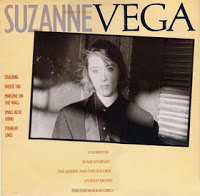
T-shirt #78: Suzanne Vega

T-shirt #78: I heart Suzanne Vega

I am grateful for many things in my life. Each morning, I run a list of these things through my head as a kind of meditation-prayer. I focus all my energy on the positive things in my life, what I love, the things for which I am grateful. Obviously, the list always starts with the people I love: my wife, my kids, my parents, my sister, extended family, dear friends, and then finally a few of the people I have never met but who have made a huge impact on my life.

Suzanne Vega is one of those people.

Funny thing? I already wrote a blog about seeing her in  concert and various thoughts on Suzanne Vega on the main blog page in my Blogger collection: Sense of Doubt:

"Old Blogs that never got posted pt. 1."

If you're interested, you can read that blog entry, which, mentions narcissism several times, yesterday's topic.
Though I am tempted to re-post the entire former blog entry here, I am resisting as I feel it's time for at least one shorter post.  The link above will you take you the original entry (and I cannot resist quoting from it here); it's a LONG blog entry, but I am rather proud of it. It examines many of the issues I am going to touch on here and more. SIDENOTE: Did you know that Suzanne Vega published a book of poetry? Neither did I until I saw someone bring the book to the concert at the Ark in 2007, hoping to get it signed. So, I tracked it down later and bought it. Good stuff.

A couple of quotes from that blog entry: "If I made a list of musical artists with whom I would like to have dinner and a good conversation, Suzanne Vega would be at the top of my list. She radiates such keen intelligence that I think the conversations would be fabulous, and she also possesses such a warm and open manner that I think I could overcome the intimidation I might feel around other “celebrities.” I am sure that I am not the only one who would like to have an extended talk with Suzanne Vega, asking questions about the origins of her songs, the choices she makes, the scope of her career, and her plans for the future" (Me, 2008).

"There’s a confluence of ideas here. Suzanne Vega, connections between people, obtaining things we love from others, learning to evaluate without using personal taste as the only criterion, how memory permeates every experience with an artist’s work. And so, returning to my original comment about having dinner with Suzanne Vega, all of these ideas would make for a great conversation, I think. I would like to hear her reaction to these ideas and her experiences with creating and performing her music. Has she had similar kinds of experiences? Have others shared with her similar stories of how they have encountered and listened to her music? What varied experiences have people shared with her?" (Me again, 2008).

A few more thoughts before I sign off.

I find it a bit odd how we consume media and become so involved with it, so passionate about it. Just looking at how we consume and enjoy our music, many of us (and this is an important distinction because not everyone does this kind of thing with music) go all in. We invest deeply in the music we love. We listen repeatedly to favorite albums, favorite songs. With favorite artists, we collect all the music available, which conveys a special status. We become experts on the music of our favorite artists. We contemplate the meaning of lyrics, and ultimately, we may fantasize about meeting the artists we love.

Suzanne Vega would definitely make a top ten list of people I would like to share dinner and discussion (as I had already written about five years ago and quoted above). Or, if I could really live my fantasy, I might expand the guest list to 13 musical artists that I would love to invite to a dinner party. I would love to talk with Suzanne, if she was willing to share, about what prompted her to write "Marlene on the Wall," "The Queen and the Soldier," or other favorite songs not necessarily from that first album. I would like to tell Suzanne how much her music has meant to me, how it has affected my life, and how many of my memories, times in my life, have her music as a soundtrack or as a touchstone. Many of us use our music as a way to fully invest in the emotions we're feeling: celebrations when happy or anger and pain when heart-broken. I wonder what Suzanne would say about her music and its role in her life, and in our all our lives, in this fantasy discussion. It's unlikely that I will ever find out.

So, I am very grateful for Suzanne Vega and all that she has given me in my life, all that I have shared with her through music, what seems like deeply personal music, without knowing her at all, though feeling like I do know her, know her music.

So, each morning, I run the list of things for which I am grateful. I am not always listing musical artists, like Suzanne Vega, because I focus mostly on my family and community. Though from time to time, musical artists will drift into my consciousness, and I will thank the universe for them, infuse the positive energy of my love into the fabric of the cosmos, because, after all, we are all connected.

LAST WORD ON THE GRATITUDE THING: I got the idea for the gratitude prayer (meditation, list, incantation, catalogue, rumination, reflection, or whatever you want to call it) from a movie called The Secret. I am not quite promoting the movie as a "true" exposure of an actual science. In fact, many of the stories in the film are a bit fatuous. However, I like watching it. I showed it to a class (my second viewing) about a month ago, and the idea of the daily gratitude thing struck me. In the movie, one of the interviewees (I forget which one and it's not important) explained how he had a rock in his pocket. At night, he would set it on his dresser with the other contents of his pockets. The next morning, he would retrieve it and remember to list the things for which he was grateful as a daily routine, like a prayer. He had a visitor from South Africa and told the man about his rock and gratitude practice. The man called it a "gratitude rock." After returning to South Africa, he wrote his American friend and asked for some gratitude rocks to be sent to him because one of his children was very sick, and he did not have the money to seek medical care for the child. The interviewee balked at sending "gratitude rocks" because, after all, "they are just rocks," he said. But he found three nice rocks and sent them to his South African friend. Months later, the South African wrote back. The rocks worked! His son was healed and recovered. They paid for his medical treatment by selling a hundred gratitude rocks. People believed in the power of the gratitude rocks.

I found this story inspirational. I do not use a rock, but every day, I make my gratitude list. I send energy into the universe. I focus on the positive and try to limit or dismiss the negative.

I think it's working.

VIDEOS - UPDATE 1312.09

In working on my post for Monday Dec. 9th, T-shirt #263, I discovered that I had this post in the "posts with music videos" category, even though it featured no music videos.

So I am updating. First my favorite Suzanne Vega song.

Marlene On The Wall - Suzanne Vega


second favorite.

The Queen and the Soldier ~ Suzanne Vega [live]


Here's a newer one.

Suzanne Vega - Songs In Red and Gray


- chris tower - 1306.07 - 8:30
updated 1312.09
updated again 1601.08

Thursday, June 6, 2013

T-shirt #77: Narcissism

T-shirt #77: Narcissism

Yesterday, my wife was reading a Time Magazine article, and she asked me if I thought that the "Millenial Generation" was more narcissistic, entitled, privileged, self-absorbed than our generation. I said no, despite the data presented in the Time Magazine article, which has its portal here (though the full article is only accessible to subscribers): "The Me Me Me Generation."

Of what Time Magazine allows us to see, one can read the following: "The incidence of narcissistic personality disorder is nearly three times as high for people in their 20s as for the generation that's now 65 or older, according to the National Institutes of Health; 58% more college students scored higher on a narcissism scale in..." (Stein, 2013).

Read more: http://www.time.com/time/magazine/article/0,9171,2143001,00.html#ixzz2VLHHSkzk

I left in the the "Read more" link because when I copied just the text from Time Magazine, the site automatically appended the text with the Read more blurb and URL. Tricksy Tricksy.

Though I am not disputing that Narcissistic Personality Disorder is a very real and very destructive force of psyche, I would like to question the data and how the National Institute of Health arrived at those statistics.

The modern world breeds conditions like Narcissistic Personality Disorder (NPD) and Attention Deficit Disorder (ADD). It's no wonder that both entered into serious study around the 1970s. Again, ADD is a very real thing, but it's also very prevalent with almost everyone in our modern world to some degree, especially among people who use various forms of technology to interact with and consume media and who engage actively in social media outlets. Because of the very nature of media, social media, and all the access technologies, everyone involved is a little (and some quite a bit more than a little) narcissistic and ADD (used in the common vernacular as an adjective for someone displaying the symptoms of ADD). But there's a significant difference between showing signs and symptoms and having a disorder. Are we a little quick to slap a "disorder" label on basic human reactions to our complex, modern world?

When I read the definition of  NPD, I find that it does not universally apply to those in my life whom I may label as narcissists or when I find that I am labeling myself as narcissistic. "Narcissistic Personality Disorder involves arrogant behavior, a lack of empathy for other people, and a need for admiration-all of which must be consistently evident at work and in relationships. People who are narcissistic are frequently described as cocky, self-centered, manipulative, and demanding. Narcissists may concentrate on unlikely personal outcomes (e.g., fame) and may be convinced that they deserve special treatment ("Psychology Today," 2013). This list features seriously damaging personality traits, such as lack of empathy and manipulations.

So back to the discussion with my wife, are the children of today any more entitled, manipulative, or privileged than we were? No. I don't think so. Granted, those of us who grew up in the 1960s and 1970s (and to some extent those from the 1980s) can grouse and complain about how much MORE the children of today have: more television channels, more product choices, more technology, just MORE. I am sure I am not the only person from my age group who has said that my smartphone has ten times the computer power and capacity of my first three computers combined. I am sure I am not the only one who has discussed with his peers how different our lives would have been if had we been plugged in the way the kids of today are plugged in with all the choices and fun games and access to media that we have today. (In fact, both these themes have appeared already in this blog and will recur as often re-visited themes.)

It's a new and different world today than the one of my childhood, and with the next singularity (or singularities) approaching as described by Ray Kurzweil (see trailer and link elsewhere on this page), the changes we have seen so far are just the beginning of changes so transformative that our culture of the near future may well be indistinguishable from the world of the 1970s in just a few years.


Not on Netflix. Not via Amazon. Buy it? Here.

And yet, are we fostering and enabling a generation of NPDs?

Wednesday, June 5, 2013

T-shirt #76: LOST

T-shirt #76: LOST

I have followed JJ Abrams' productions ever since his first offering to the TV viewing public as co-creator of Felicity, which aired on the WB from 1998-2002. Though I have not watched everything he has created (skipping Undercovers, Person of Interest, and Revolution), I am a very big fan of Alias, Fringe, and LOST as well as the films, such as both Star Trek films and Cloverfield.

I spotted LOST as a show with potential from the start, jumping on from the first episode. Right away, I was hooked. LOST aired on ABC from 2004-2010.

LOST accomplished something that few other shows had managed or had not managed with a high level of popularity. Abrams and his posse of creators (including Jeffrey Lieber and Damon Lindelof among others) wove a complex story with dozens of lingering questions for viewers. LOST was filled with unexplained phenomena and intricate mysteries. The reveals that were spread out over its six seasons often produced more questions than answers. The show generated enormous fan chatter on the Internet, as Web 2.0 really came of age during the show's run. A heavy traffic of speculation and discussion filled chat rooms, message boards, web sites, blogs, and various outlets of social media. I did not pay much attention to all of the chatter. But I did engage in discussions with other LOST viewers about what it all might mean. And though I was not quite as disappointed in the finale as many of my friends, I was not entirely blown away and thrilled with it either. Ultimately, LOST collapsed a little (though not completely) like the house of cards it is. It's a great ride as a work of episodic fiction, but the pay off is not quite as astounding as the promise of its complexity and mystery.

LOST may be the best example on the current media landscape of the novel for television told in episodes. For many years, television networks resisted formats that would preclude new viewers from jumping on midway through a season or an entire run of a series. Networks also had a vested interest in milking a money-making product to death rather than agreeing to allow a show to reach a natural conclusion. LOST is one of the first, and surely the best example, of a show with a rich mythology that will be impenetrable for anyone to attempt to jump on mid-stream. The show must be watched from beginning to end in the same way a novel must be read from beginning to end. No one would try to start a novel in the middle and attempt to figure out what's going on as he/she reads, or if someone tried, he/she would indeed be "lost," depending on the intricacy of the novel.

LOST thrived in this new format because past episodes were readily available on DVD, Internet downloads, and eventually via streaming technology. TV networks finally realized that many, many people would willing devote themselves to TV novels. Others who missed out on regular broadcasts would buy or rent all the DVD sets to catch up. People yearned for a longer, sustained experiences rather than a series of stand alone episodes with a few arcing story elements woven throughout. Television had entered a new era. No longer were TV shows relics of the past that were discussed with reverence and longing. Because unless they were in reruns somewhere or stored on ancient video tapes, these shows only existed in memory and in an oral tradition or describing their brilliance to others. Many shows from the pre-video tape era were hidden away in the TV studio archives, waiting for the technology that would set them free and make them accessible. Now with streaming technology, many beloved artifacts of long ago decades of entertainment are available with a few clicks of a button, forever changing the way we consume and interact with our media products. And these changes are only the beginning. In our lifetimes, we are due to see even more significant changes to our media experiences.

Another aspect of people's desire for the sustained, episodic narrative woven intricately with mysteries galore may not have occurred to the corporations who fund and profit from these projects until the advent of LOST, though the storytelling methods can be observed in other series' that aired prior to LOST. Watching a program like LOST binds people together in an exclusive club. A viewer gains a special status by watching--let alone studying--the program. More status is conveyed by those who expend the most energy in speculation and discussion. LOST fans can speak in a special language only understood by other LOST fans. They have special knowledge. They have the secret key to powerful mysteries and engaging, cerebral puzzles. They keep secrets from non-fans, if only to preserve the surprises and plot twists, the "truth" and the exciting cliff hangers for these non-fans who may, at some point, become fans.

Critical reception ranks LOST among the best TV shows of all time, and I agree.

- chris tower - 1306.05 - 9:26

Tuesday, June 4, 2013

T-shirt #75: Spektrmodule

T-shirt #75: Spektrmodule

 I like Warren Ellis.

For those who do not not know who Warren Ellis is, check here: Warren Ellis web site.

Warren Ellis, the author (not the musician who works with Nick Cave), describes himself thusly: "WARREN ELLIS is a graphic novelist, author and columnist. His new novel, GUN MACHINE, available now from Mulholland Books, is being developed for television by Chernin Entertainment and FOX. His first non-fiction book, from FSG, is due in 2014. RED 2, the sequel to the Bruce Willis-Helen Mirren film RED based on his book of the same name, will be released in August 2013" (Warren Ellis, 2013).

Planetary #26


Additionally, I would add many of his other credits to who he is and why I like him. Ellis did not hit my radar until I started reading Planetary, a comic book from DC/Wildstorm, which may be my favorite comic book thing concocted from his mind (and that of the the brilliant artist John Cassady). Once I realized how much I was loving Planetary, I back-tracked to read his other stuff: The Authority, Transmetropolitan, and his work for Avatar Press with the Gravel graphic novels among others. When Planetary ceased publication due to a disagreement between Ellis and DC, he forged ahead with many other books that quickly catapulted him to status as not only my favorite comics writer but one of my favorite writers, period. Notables from this time period include Global Frequency, Fell, Doktor Sleepless, and genius run on Iron Man, which gives us the Extremis storyline that I am told is the basis for the Iron Man 3 movie (though I have not yet seen it).

And, of course, there was FreakAngels, which I discussed with T-shirt #22.

The Wiki page is not very good for gaining Ellis knowledge. There are probably better compilations of his career to be found on the web somewhere. I did not look, but I suspect there are fan sites to be found.

But, wait, there's more. Since 2008, I have been plugged into Warren Ellis' wired presence in cyberspace. He runs a website which he updates frequently, and since it runs on blog-software, I can load an RSS feed in a reader  that I check daily. He sends Twitters, and though sometimes he goes off for 20-30 in an hour (like the time he broadcast his views on whisky and whiskey from a pub somewhere near London to the tune of 45 messages in 90 minutes), I allow his messages to go through to my phone because he is endlessly entertaining and thought-provoking. He started an email newsletter to promote his Gun Machine book, which I pre-ordered and read, after which, I re-read his first book Crooked Little Vein via the excellent audio edition. He has many recurring activities, such as bookmarks of interesting research, Night Music (of which three of his posts are embedded on this blog page), and website station idents, sometimes posted by guests and other times as weather updates from his home near London with text overlaid on photos.

One of his most recent projects (he calls it a "hobby") is a podcast series entitled "Spektrmodule." As of this writing, Ellis had just broadcast Spektrmodule 23 - "Cloud Circuitry." Here's what Ellis had to say about it in his most recent Machine Vision #50 "Sundays" email newsletter: "First off, I wanted to mention that there’s a new SPEKTRMODULE podcast, since some of you seem to like that sort of thing.  I seem to be doing a two weeks on / one week off kind of schedule with it right now.  Still utterly amazed at how many people listen to it."

Ellis describes Spektrmodule as "a podcast of haunted, ambient and sleepy music I compile for my own amusement."

I have found a great deal of synchonicity with Warren Ellis. Before I plugged into his online broadcasts, I was already a big fan of "haunted, ambient, sleepy music" going back to Eno's pioneering work, Bowie's Berlin albums, David Sylvian, Holger Czukay, Harold Budd, Robin Guthrie, William Orbit, Robert Fripp, the Penguin Cafe Orchestra, Laraaji, John Hassell, and many more. I would add Tangerine Dream to that list but for some reason Tangerine Dream has always freaked me out. But Aphex Twin's and Future Sound of London's creepy ambient work has given me many haunted, sleepy nights.

Ellis takes the name for Spektrmodule from the Russian Mir Space Station project. The fifth module of the station was known as Spektr, designed for remote observation of the atmosphere and surface of the earth. Ellis describes the origin of his podcast name in the first episode of Spektrmodule. In 1997, a collision with another vessel punctured a hole in the hull of the Mir. The resulting de-pressurization required that the entire station be sealed off. As Ellis describes, "the crew had to sever the power cables to the module with fire axes. Fire axes on a space station. Who thinks of that?" (Spektrmodule 01, 2011).

Find the podcasts here: SPEKTRMODULE.

If you like haunting, sleepy, ambient music, you will like them. Trust me. I'm a doctor.

UPDATED: 1401.14 with link for Spektr and image below.


SIDENOTE: Ellis is always on about interesting things. He works with ideas. Part of his appeal is that he freely shares his thinking to the world. Not all of it, mind you, but a good share of what's going on in his mind is on display to the world in his posts, Twitters, emails, and podcasts. One such post, which he is still unpacking, is a little investigation analysis he called "The Manfred Macx Media Diet," after a character in a free e-book serial novel published via the Creative Commons license by Charles Stross. This is the kind of thing that keeps me paying attention to Ellis. If you have time, follow the link and read the column. If you consume media, and if you are curious about how we consume media, you will be interested.

- chris tower - 1306.04 - 8:25

Monday, June 3, 2013

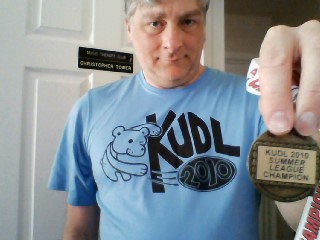
T-shirt #74: KUDL Blue 2010: Championship Team

T-shirt #74: KUDL Blue 2010: Championship Team: TOWER WINS!

My team won the Kalamazoo Ultimate Disc League Championship in 2010, the league's fifth year of existence.

Though I have I have featured Ultimate shirts four times so far in this blog's history (T-shirt #56, KUDL 2009; T-shirt #58, Grey Area; T-shirt #59: KUDL 2007, and T-shirt #60, MUSL 2007), and though one of those (Team Venom, T-shirt #60) won a championship, and though I have been on a few teams that have won Ultimate accolades (my team won the first ever Huckfest in 36 degree temps, sleet, and winds of 25-30 MPH), I am most proud of this win as the KUDL champions of 2010.

I knew we had a good team from the start of the season. I had a great draft, picking Andy "Big" Momotiuk with my first pick. I was lucky enough to also draft a lineup of players that would prove to play well. Though we did not dominate the regular season, we won the tournament. Our "all-star" lineup: Paul Abueva, Chris Carew, Brian Finch, Jeff Fingas, Hether Frayer, Arik Lentz, Maggie McKinney, Andy Momotiuk, Merrill Murphy, Tom Owen, Eric Parker, Lisa Phillips, Michael Serota, Piper Simons, Sarah Spruit, Chris Tower, and Ben VanGelderen. ** Karli Silverman

Though Maggie and Eric would drop after week one, the rest of the team hung together and played together.
Because we lost a woman draft pick, we picked up Karli Silverman, who had her best year playing Ultimate with our team! Despite our good lineup, we went into the tournament seeded third overall and second in the B pool out of ten teams. We managed to win our pool, beating the Crimson team (number two seed and number one in our pool) in a tough, hard fought game at the end of pool play. We won through quarters and semis to meet Nickel, the number one seed overall, in the finals. Lisa Phillips turned in an MVP style performance catching seven of our goals in the Finals. Our team out played Nickel, though it was hardly easy. The Nickel team was very good and much respect is owed to them.

I remember trying to find the words for a halftime pep talk to my team. Though I do not consider myself a dominant player and great strategist as a captain, I do consider myself good with many other captaining tasks, such as team spirit, team communication, and managing people's playing time. I tried to make a short speech to keep the troops rallied. We were leading at half, and it looked like we might win the tournament, but the win was not yet in the bag. As I tried to talk, I became overwhelmed with emotion, too choked up to speak. I started to cry. My heart was full. I loved each and every person on this team, and I wanted to thank them for playing hard and making 2010 my best summer league ever. But I couldn't find the words. 

I felt transported back to the playgrounds and gym classes of my youth, when I was the last one picked to be on a team, or when the teacher would have to force a team to take me. I was an awkward boy and struggled with coordination. I did not have much strength, especially in the upper body. I lacked confidence and did not have the friends to support me and practice for better ability to compete in sports. If I had walked a different path, I might have played Little League, played high school Baseball, maybe even played college ball. But sports were not part of my childhood skill set. I discovered Ultimate as an adult at the age of 22, by which time I had gained enough coordination and self-confidence to be passably good. I also had the friends to encourage me and support me, even when I made mistakes or showed that I was far from a top-notch athlete or a dominant, game-changing player.
And so, on those fields, in the hot sun, on that day in August of 2010, I could not speak the words in my heart. My teammates realized how I was feeling, and how much it meant to me to win this league, and our cheer at half time was "Win for Tower." I have never been more proud of a moment in my history of playing Ultimate (nearly 30 years).

My team won the league championship. Everyone played a role and contributed to the win, and though we were tested by a strong Nickel team filled with excellent players and good athletes, we managed to do the little bit extra that resulted in our winning.

I have always insisted on trophies and keepsakes for the league. In 2010, in an effort to save money, and because other people are not as fond of medals as I am, we did not have any made for a trophy presentation at the fields following our win. I had these medals made later and distributed them to our players.

Our team in 2010 was called COOL PATROL, named after a toy truck that some child left many years ago in the chair I carry to the fields. The truck bears the label: "Cool Patrol." I had suggested the name many times for teams, and this was the first group of people to embrace it.

We were indeed the COOL PATROL.

Though we now have an official KUDL trophy on which my teammates' names are all inscribed (much like the Stanley Cup), it's the makeshift, crappy, gold-painted, flower pot trophy that our KUDL founders all covet, with its stick-on letters from our first year as a league when we called ourselves KUSS (2006). Pictures of our current KUDL trophy, the old KUSS Kup, and this year's 2013 KUDL logo are featured in today's blog entry.


Today, Monday June 3rd, we launch the eighth year of our Kalamazoo Ultimate Disc League (KUDL) with ten teams for only the third time in our league history. Though we have a large number of players registered this year, we are still trying to recruit more for the future, especially women players as we like to maintain a gender ratio of at least 5-2 (five men/two women) if not 4-3 on the field at any time.

After the jump break, some shout outs to the Cool Patrol team, and a historical record of the KUDL winners thus far.

PLAY ULTIMATE!

Sunday, June 2, 2013

T-shirt #73: Battlestar Galactica

T-shirt #73: Battlestar Galactica

Yesterday, I shared my fifth Star Trek post and a variety of thoughts that add up to one incontrovertible conclusion: Star Trek makes me happy.

And though Star Trek wins out in my heart as my favorite SF TV show, this is simply due its longevity, its origins in my childhood, and the sheer volume of its stories.

And yet, I would argue that the revised version of Battlestar Galactica is better. And though I acknowledge the excellence of many SF TV shows, such as The Prisoner, Space 1999, Babylon Five, Firefly, and Stargate, (Sorry, I am not a Doctor Who fan), I would argue that the updated Battlestar Galactica is better than all of them.


In fact, I think I could make a compelling argument that Battlestar Galactica (BSG) is one of the best action/drama TV shows of all time....yes, OF THE ENTIRE HISTORY OF TELEVISION.

Battlestar Galactica aired on the Sci-Fi Channel from 2003-2009. A remake of the original 1978 television series, the new BSG saga comprised 75 episodes over four seasons. Battlestar Galactica earned great critical acclaim and awards and inclusion in the Time Magazine Best 100 TV shows of all time. The Time Magazine list is not ranked and includes all TV shows, which seems an unfair comparison to put Battlestar Galactica in the same list as The Abbott and Costello Show or ABC's Wide World of Sports.

Battlestar Galactica would surely make my top five favorite all-time TV shows, though I hesitate to make a top five list that is not separated by genre. Certainly, Star Trek, Lost, and Buffy the Vampire Slayer would make this list. Though I love A Charlie Brown Christmas, (which is in Time's list), I would not include one-shot programs in a favorite all time list. Comedies and reality TV shows (I do love Survivor) would be relegated to separate lists for their respective genres. And, really, I would not rate a show like Battlestar Galactica next to shows like Gilmore Girls, Veronica Mars, or Felicity, which really fall into another category entirely.

Why was Battlestar Galactica so good? Pathos. The show featured razor's edge tension and cathartic pathos unlike any other SF or "fantastic" TV show of its kind. The acting was superb. The writing was superb. The visual and sound effects won Emmys. Edward James Olmos and Mary McDonnell rocked the park. It's full of surprises and mysteries and intricacies of plot, character, and long term story building (as certain elements of the show's finale are set up in the show's original mini-series).

But at first? If you know the 1970s program, there are adjustments to make. Starbuck is a woman?? WHAT?? Cylons are human-looking??? HUH? Stick with it. Because the punch it packs is unlike anything I have ever experienced in episodic TV. In the end, for its overall excellence, I would rank it above both Lost, and Buffy the Vampire Slayer, which I loved dearly, but which had flaws that BSG lacked.

A promotional image for BSG modeled on the Last Supper painting.
Battlestar Galactica fandom is still alive and well.

Battlestar Galactica: Battlestar Galactica.com, Richard Hatch inspired site dedicated to showcasing the BSG Universe and Promoting Battlestar Galactica.

Galacticon Three was held earlier this year (2013).

A prequel episode aired online in 2012: Blood and Chrome.


More Battlestar Galactica fandom:

Battlestar Fan Club

There's fan fiction, fan gear, and more that's just a Google click away.

But, really, if you have not watched this TV show, get started. Even non-SF fans should love it.

In closing, an image of the DRADIS (the defense system, like "radar," for the Battlestars) created by my friend Ryan Walters for my birthday a few years back.

ENJOY!

- chris tower - 1306.02 - 11:53