.jpg)
.jpg) T-shirt #332 - CBLDF - Frank Miller - Fight Censorship
T-shirt #332 - CBLDF - Frank Miller - Fight CensorshipThis is a weird cheat. Hello from the future. When I originally posted this blog entry on February 16th, 2014, all I had were pictures. See here the shirt from the Comic Book Legal Defense Fund. In one picture, you can see the matching signed print, by Frank Miller, over my left shoulder. Then another two shots shows the print on my office wall, both close up, and among the other art work hung there.
.jpg) I created this blog entry during a busy time in my work schedule (teaching classes) and my class schedule (taking classes). And so I just posted the pictures and a note about the incomplete nature of the entry.
I created this blog entry during a busy time in my work schedule (teaching classes) and my class schedule (taking classes). And so I just posted the pictures and a note about the incomplete nature of the entry.However, since then, I have ended the blog year, as I did on March 21, 2014, and though I plan to finish all incomplete entries on the blog and write new ones, this is the first finishing since I closed down the daily transmissions in March.
Since then, I have read and reviewed The Ten Cent Plague and posted the review to my other blog, which, seems to me, to be the perfect content for this blog entry.
ENJOY.
- chris from the future
.jpg)
.jpg)
 The Ten Cent Plague book review
I have owned The Ten Cent Plague for six years, having bought it when it was originally published. It's one of those books that I have wanted to read very much, and so it has held a place in various "to read" book stacks for several years. You know the ones. At first, it's in the newly purchased books to read stack. And then it gets shuffled out of the stack of the recently purchased and yet continues to find its place in the entire book case I have devoted to "books I want to read." Not that I have confined all of my unread books to one book case (three shelves), I have several other "to read" areas in my home, which, if you are reading, this blog, then you surely understand as you probably have such devoted places, too.
Okay, smart aleck. Yes, some of you have quite given up your "to read" stacks of actual, physical books printed on paper. But I bet you have a digital book wish list or a "to read" folder on your reading device. Since I consider myself a comic book maven, a serious student and appreciator of the art form, I had to purchase The Ten Cent Plague. I still like actual books on paper, and though I consume a few in digital form, I still prefer the heft of a book, especially a hardcover edition, and the smell and feel of paper. But my reading of actual books, in the old method of scanning words on the page with my eyes, has been substantially reduced. For one thing, my reading time is limited, even though I carve out just as much of it as possible. Comic books, sports writing, game materials, and other assorted interests further reduce my available time to read actual books on actual paper with my actual eyes.
(SIDENOTE: In fact, I am just about to take about three hours for Baseball and reading, one of my favorite activities on a Sunday afternoon.)

And though I try to apply myself to a few nonfiction books per year by "reading reading" them, my term for actual reading in the old fashioned sense, I never manage to get through as many as I wish. But when I see a book on Audible or Amazon as available as an unabridged audio book, it's likely that such a book will rocket closer to the top of my "books to read" stack. I "read" about 90-95% of the books I consume per year in audio form. Or rather, listening to audio books has increased my books read per year by almost ten times. Even so, I have a back log of "books to read" in my audio folder, and like the actual stack, The Ten Cent Plague sat in the virtual stack for quite some time as well.
Whichever kind of reader you are, I am sure you understand how a book can orbit your attention span and your active reading habit for several years, caught in the gravity of your interest but just out of reach of being snared and brought to earth, your reading pulpit. Such is the case with The Ten Cent Plague by David Hadju.
 I just finished this one the other day, and I have to give it my highest recommendation. Because of its focus on the content of comics in the late 1940s and 1950s, the cultural war waged against them, and the emergence of Mad Magazine, with deft writing and strong research, David Hadju has written an impeccable and riveting examination of this time period with The Ten Cent Plague. Comparisons to World War Two abound, and though some extra information about what followed this tumultuous time period would have improved the content, overall, this is an excellent book. Most reviews seemed to concur. I checked Amazon, as I usually do, to see the reviews, and I was pleased to see that the five star reviews (33) far out-number the others: four star (19), three (5), two (four), and one (3). As always, there are some idiotic reviews that could send me into a tail spin if I let them. There are idiots who cannot understand how this well-written, well-researched book has so many positive reviews (while even admitting that the book is well written and researched), but I can ignore these, especially if I do no more than glance at them as I did.
Since I listened to this one, it played on my iPod player in my house off and on for weeks. One time, overhearing the narration concerning some civic action groups motivating against comic books, my wife said "is this for real?" That the crazy, fascist-like activities of the post-World War Two do-gooders, who had recently helped to free the country of the potential tyranny of the Third Reich, would pursue the same blinded, fear-driven crushing of freedom and support of censorship seems completely insane, and yet it happened, even though the story of what happened seems almost fictional today. Chalk this one up in the "how soon we forget" category along with the flu pandemic of 1918 and other horrors.
"I think Hitler was a beginner compared to the comic book industry," wrote psychiatrist Frederic Wertham, famous for the the 1950s exposé The Seduction of the Innocent, which "indicted comic books as a leading cause of juvenile delinquency" (Hadju pg. 6). "The time has come to legislate these books off the newsstands and out of the candy stores."
 Looking back, the comparison between Nazi Germany and comic books seems absurd as it and the whole witch hunt of the comic book industry seemed to my wife when she overheard me listening to David Hadju's The Ten Cent Plague. But these were serious allegations in the post-World War II era of the late 1940s and 1950s as Americans had to step lightly around accusations of Communist infiltration and influence as well as the mounting hysteria over the stalemate of the Cold War. The new Hitler was entirely invisible and far more insidious, and yet Americans wanted the same easy fix. Removing the Nazis and Hitler (as well as the fascist regime of Italy and Japan) from Europe healed the world. But there were threats that were not just camped on the borders, they were invading and attacking. Hitler had swept through Europe, and the Nazis were bombing England, before they were defeated. The Japanese had attacked Pearl Harbor and threatened the American Way from the other direction. With these threats eliminated, the protectors of the good, decent, and true spirit of freedom wanted another tangible and invading enemy to stamp out of existence. Like the "Communist Party," comic books became one of those enemies. And though comic books were not as crushed into defeat as the Nazis, the industry shrunk dramatically and one company, EC Comics, basically ceased all production.
 The battle became the young versus the old. As television and rock and roll became more prominent and popular, comic books became the first big battle for young people versus their parents with class, money, taste, religious dogma, political agendas, and these new art forms as the battleground and ammunition.
At the height of their original heydays (starting in the post WWII 1940s), comic books led the pack in America as the most popular form of entertainment, selling an astounding 80 to 100 million copies each week. Some 650 titles were released each month, and the industry employed around 1,000 writers, artists, and editors (Hadju, pg. 5).
After the original volleys of superhero books spewed forth from publishers, comic books took a turn, striving to attract older audiences, those who devoured the old pulp magazines of the 1920s and 1930s and the many dime novels with their lurid covers and "adult" themes. Leading the way in this new wave of comic books was EC, Entertaining Comics, headed by the genius William Gaines.
 Soon, the shelves were filled with comics devoted to crime, horror, science fiction, and romance. By the end of 1952, nearly one-third of the comic books on stands were devoted to horror and the "macabre" (Hadju, pg.189). Most others were romance and crime-related as the taste for super hero titles waned. Leading the way, EC published the most extreme material, which is still some of the best comic book work in the history of the genre to this day. But in during the "Happy Days" era of the 1950s, the subject matter proved disturbing to the old school establishment adults who had lived through the Depression-era followed by the Second World War. Focused on horror and crime, EC's comic book were gruesome, featuring severed heads, unremitting killers with no remorse, and plenty of blood. The stories also emphasized sex, displaying women in diaphanous negligées, visible cleavage or tight clothing with art work that focused closely on the bust, and overall realistic drawing of women rendered beautifully. The artwork depicting the women were suitable for pinning up. In addition to romance, there plenty of "jungle girls," such as Matt Baker's Tiger Girl and Jerry Iger's Sheena (Hadju, pgs. 157-58).
 Publishers competed for readership with increasingly more shocking and extreme imagery and story lines. Stan Lee, then working for Timely, described the problem best: "the horror craze was a challenge for the average publisher because you had to come up with new ideas for every story... not everybody could do it...book came and went because they petered out. The editors couldn't sustain the interest, so they used a lot of tricks to get the reader's attention" (Lee as quoted in Hadju, pg.190).
At the time, under Lee's stewardship, Timely was the most successful publisher in 1952 with sales half again as great as next competitor Dell and double that of National/DC. Still, publishers scrambled to outdo each other, gain readers, and match EC's success.
If a character had his neck slashed in February, in the March issue a character would be decapitated. In another issue, a human head would be used as a bowling ball, and in another, a woman would roasting her husband's body parts (head, a leg, hands, feet) on a barbecue grill.
Such content sparked a national campaign against comic books, the biggest loser of which was EC, who was driven virtually out of business except for one publication, Mad Magazine (more on that one in a minute). Like millions were massacred in WWII, comic books suffered a gutting in a cultural war that left hundreds of talented artists scared off or even blacklisted. The national crusade against the "corrupting" influence of comic books led to bonfires of comic books sponsored by churches and schools and eventually a Senate hearing that most abused William Gaines and EC.

Scrambling to stay in business, the comic industry chose to self-regulate and created the Comics Magazine Association of America in 1954, watchdogging its product by promoting "wholesomeness and virtue" (Hadju, p. 319). In the CMAA Code, the police were never to be depicted with "disrespect," no comic book could use the words "horror" or "terror" in its title, and all "lurid, unsavory, or gruesome illustrations" were forbidden. The depiction of the "walking dead, vampires, ghouls, werewolfs, and cannibals" and "words or symbols which have acquired undesirable meanings" (whatever that means) were forbidden (Hadju pp. 291-292). Many comic book companies turned to "cute" books to survive the backlash against its more popular and adult titles. Harvey came to prominence in this era with Casper the ghost among others and oddly "Hot Stuff," even though the main character was an actual little devil, complete with horns, a tail, and a pitchfork (Hadju, pg. 315)
Between 1954 and 1956, more than half the comic books on the newsstand had disappeared (Hadju, pg. 326). The number of titles dropped from 650 to 250. By the end of 1955, EC discontinued all its comic books, keeping only Mad, which became Mad Magazine, since magazines were not subjected to the same regulations as comic books by the CMAA. Five other publishers went out of business completely: Star, Sterling, Toby Press, United Features Syndicate, and Eastern Color.

"Everybody was punished," said Carmine Infantino (who died last year as I featured in my T-shirt blog in shirt #20 devoted to the Flash). "It was like the plague. The work dried up, and you had nowhere to go because comic were a dirty word, You couldn't say you were a comics artist, and you had nothing to put in your portfolio. If you said you drew comic books, it was like saying you were a child molester. It was a nightmare, especially for a lot of people who got into comic in the first place because, you know, that was where we could go" (as quoted in Hadju, pg. 326).
And yet, Mad Magazine survived the tumult and even thrived as the few comics that remained held their ground awaiting the resurgence that would start in 1961 with The Fantastic Four. Robert Crumb expressed the power of Mad well: "it was really the coming together of everything that was great in EC and some of the other comics before the Code... Here was a publication making fun of highly respected American institutions in the square, military, post-World War II environment and doing so in a crude, weird way... It countered all the stifling, goody-two-shoes fifties-propaganda totalitarian vision that was put forth in the media, the schools, and everything. A big of its appeal is that it was so strange and esoteric and outside of this mainstream" (as quoted in Hadju pg.333).

Mad debuted before the national crusade decimated the comic industry and stayed on to thrive. The first issue of Mad debuted in August of 1952. From the beginning, Mad was "giddy adolescent fun" (Hadju, pg. 199). However, Mad was not an instant hit. At first, the first four issues, lost money. And then, it all clicked.
"Mad became a forum to mock all of American culture; ... it took aim at adult society with the weaponry of the schoolyard: funny faces, cat-calls, relentless silliness, rudeness, and cruelty" (Hadju, pg. 215). The defining artistic force that helped Mad out of the red and into the black was Will Elder. He called the element he brought to Mad "chicken fat. Gaines maintained that Elder "defined Mad's approach to humor as pure mayhem. Idiosyncratic, indulgent, digressive, and uneven but uniquely potent in its accretive effect, Elder's work was wholly American art, a rough counterpart to the majestic, overstuffed improvisations of Walt Whitman or Charlie Parker, transferred to the literature of the playground" (Hadju, pg. 217).
EC also produced a companion humor comic to cash in on the success of Mad like so many other publishers who aped it with their own knock-offs in 1953.
 If there's a negative to Hadju's book, and I hesitate to give it one, it's that the take ends abruptly with the death of EC (except for Mad Magazine), and Hadju spends very little text on what happens next. The follow-up to the success that Mad Magazine has is cursory and filtered through an interview with Robert Crumb, which is all well and good as a start but fails to do justice to the place of Mad Magazine as a cultural paradigm shift and defining force. Likewise, Hadju devotes very little text to the recovery of comics in the 1960s. Granted, neither of these follow-ups convey the story he wished to tell, but more epilogue follow up and some well-reported facts would have capped off The Ten Cent Plague in a better way.
Nevertheless, I give The Ten Cent Plague five stars without hesitation. It is an excellent book, and even well narrated as an audio edition.
As a final note on the cultural war against comics in the 1950s, there an ironic connection that can be made between the war on comic books and an immensely popular science fiction novel. Ray Bradbury's Fahrenheit 451 came out in 1955 showing a frightening future in which books were outlawed and large bonfires were set ablaze to destroy the illegal "thought-crime" texts. Three types of publications were so beneath contempt by this future government as to escape the fires: trade journals, pornography, and comic books (Hadju, pg. 303-304). Coincidence or Bradbury's parting shot after years of working in comic books, providing stories for adaptations by EC Comics? Whatever the case, the bonfires of comic books in the 1950s now seems like fiction, as my wife asked while over-hearing this book: "did that really happen?"
MY OTHER BLOG WORK ON THIS AND RELATED SUBJECTS
I have a few blog posts over on my t-shirt blog about censorship as listed here:
T-shirt #63: Comics Code Authority
T-shirt #159: Save smut! CBLDF shirt one
T-shirt #254 - Fight Censorship: Chester Brown
T-shirt #332 - CBLDF - Frank Miller - Fight Censorship (this one is incomplete)
Maybe I should also post this text there back in the past. :-)
I devoted a single post to EC Comics on the t-shirt blog (though more to come):
T-shirt #156: EC Comics
I also wrote about Mad Magazine twice on my t-shirt blog:
T-shirt #92 - Mad Magazine (first Weekly Comics List post!)
T-shirt #264 - Alfred E. Neuman Faces
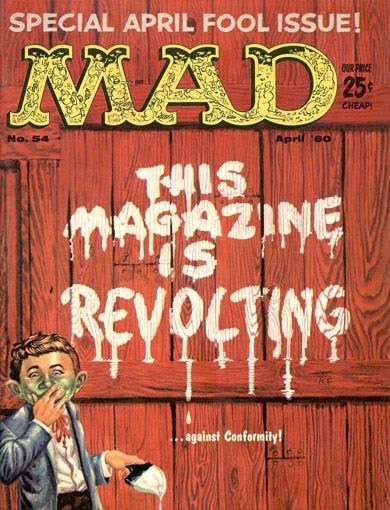
To conclude, a cover gallery of some EC gems, some Matt Baker art (romance and Phantom Lady), and assorted others, including a bunch of Mad Magazine covers not featured on my t-shirt blog.
COVER GALLERY




- Bloggery committed by chris tower - 1407.06 - 11:39
COUNTDOWN TO END OF THE BLOG YEAR - 33 shirts remaining
- chris tower - first published - 1402.16 - 20:15
updated - 1402.17 - 19:42
final publication - 1407.08 - 10:21
updated - 1402.17 - 19:42
final publication - 1407.08 - 10:21

.jpg)


.jpg)


